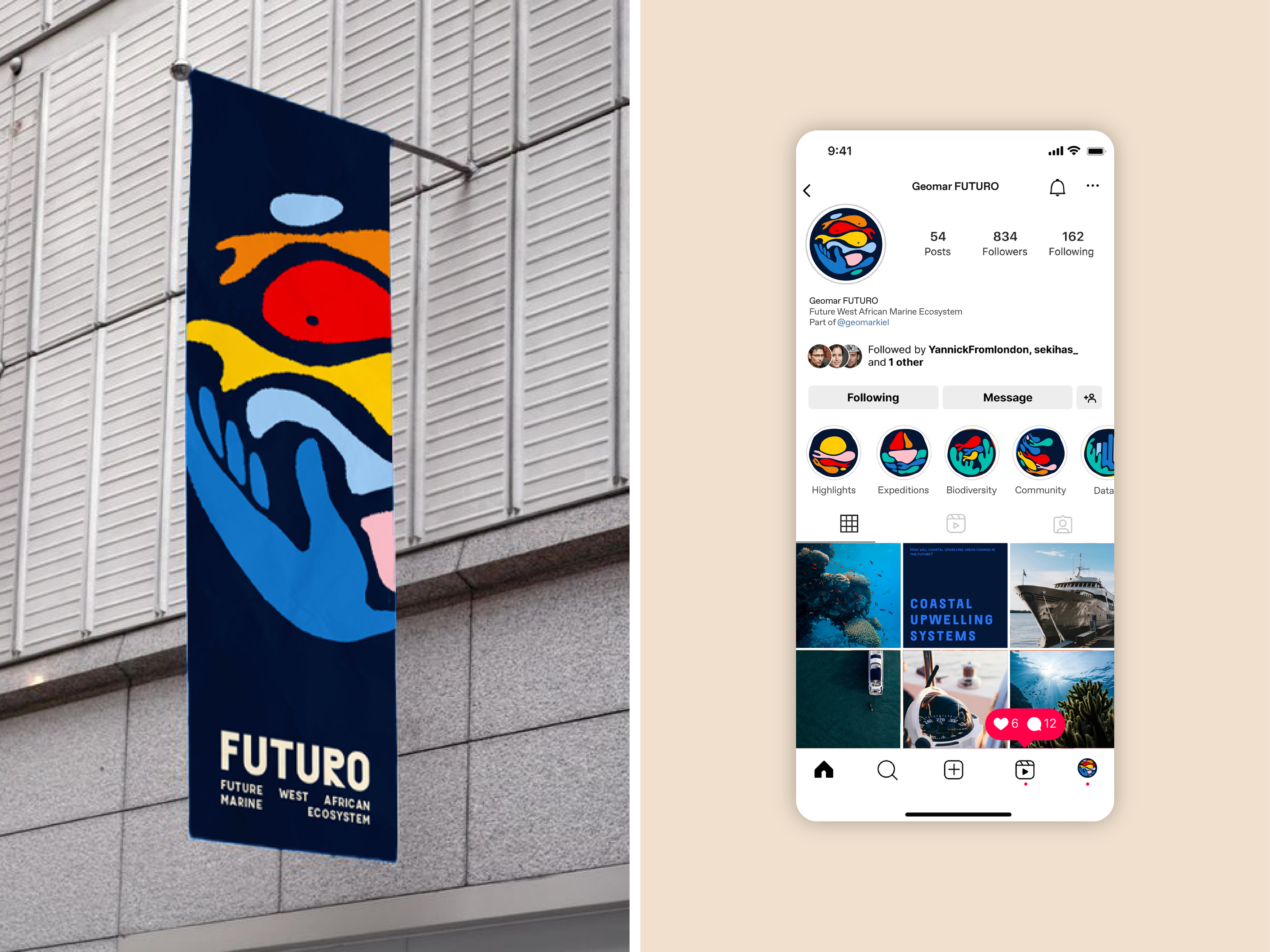
A visual system for the future of marine ecosystems
How do you communicate a research initiative that addresses climate change, biodiversity, fisheries, education, and international collaboration all at once? FUTURO – The Future West African Upwelling System – explores one of the world’s most productive yet highly sensitive marine regions: the tropical upwelling system in the Atlantic off the coast of West Africa, where ocean dynamics, climate, and human livelihoods directly influence one another.
For GEOMAR, Studio Oeding developed a digital campaign platform that translates scientific complexity into accessible communication while connecting diverse stakeholders. The multilingual website brings together research, social relevance, and international cooperation within a clearly structured and visually driven communication platform. At the same time, it positions FUTURO as an independent international initiative within the context of the UN Ocean Decade.
Task
Studio Oeding developed the strategic and visual foundation for an international science and communication campaign for FUTURO. The goal was to translate the complex content of the research initiative into a clear, accessible, and distinctive brand and communication platform.
This included the concept and design of the campaign website, the information architecture, the visual guiding idea, and a flexible design system for international communication. Special focus was placed on making scientific content understandable while positioning FUTURO as an independent initiative within the context of global research and sustainability programs.
Idea & Concept
At the heart of the concept lies the translation of scientific knowledge into open and accessible communication. The design connects research, international collaboration, and social responsibility within a distinctive visual identity that provides orientation for scientific institutions as well as political, regional, and social stakeholders.
The campaign was conceived as a platform for exchange and collaboration. Maps, illustrations, large-scale imagery, and concise content make ecological relationships visible while highlighting the project’s international network – from research institutions in Europe to partners and communities in West Africa.
A particular focus lies on education and knowledge exchange. Programs such as the WASCAL Floating University, as well as collaborations with regional initiatives and the Ocean Science Centre Mindelo in Cabo Verde, underline FUTURO’s long-term ambition: not to treat research in isolation, but to develop sustainable perspectives for future generations together with local stakeholders.
Execution
The website combines clear user guidance with a modular and scalable design system. Different layers of content – from scientific research questions and global ocean observation systems to education and co-design processes – are visually differentiated and presented in an accessible way.
Large-scale photography, cartographic elements, and illustrative visualizations create a distinct visual world between science, ocean, and future vision. The multilingual architecture supports the project’s international scope and strengthens accessibility for both regional and global stakeholders.
The platform was developed so that FUTURO can operate flexibly as an independent campaign alongside partner institutions such as GEOMAR, GOOS Africa, or the UN Ocean Decade, without losing its own identity.
The result is a digital communication space that not only communicates scientific knowledge, but also makes international collaboration, participation, and collective action visible – for the future of marine ecosystems off the coast of West Africa.